

Namibian Adventures April 2023
We left South Africa at Vioolsdrif and crossed into Namibia via the Noordoewer border post. The Orange River splits Namibia and South Africa. There are several opportunities where you’ll stand on the riverbank, and you know you’re staring at another country. Quite a cool realisation! We spent our first evening at Amanzi Trails base camp. The next day, we started out day very early and were on the road by 5 AM to head to the Fish River Canyon before getting to Duwisib Castle. Catching the sunrise on the road was magnificent. To see the colour of the landscape including the dunes change from black to golden red, to orange to yellow was phenomenal. We did stop on the road to enjoy a coffee, soak in the moment and take a photo or two, or ten.


Fish River Canyon
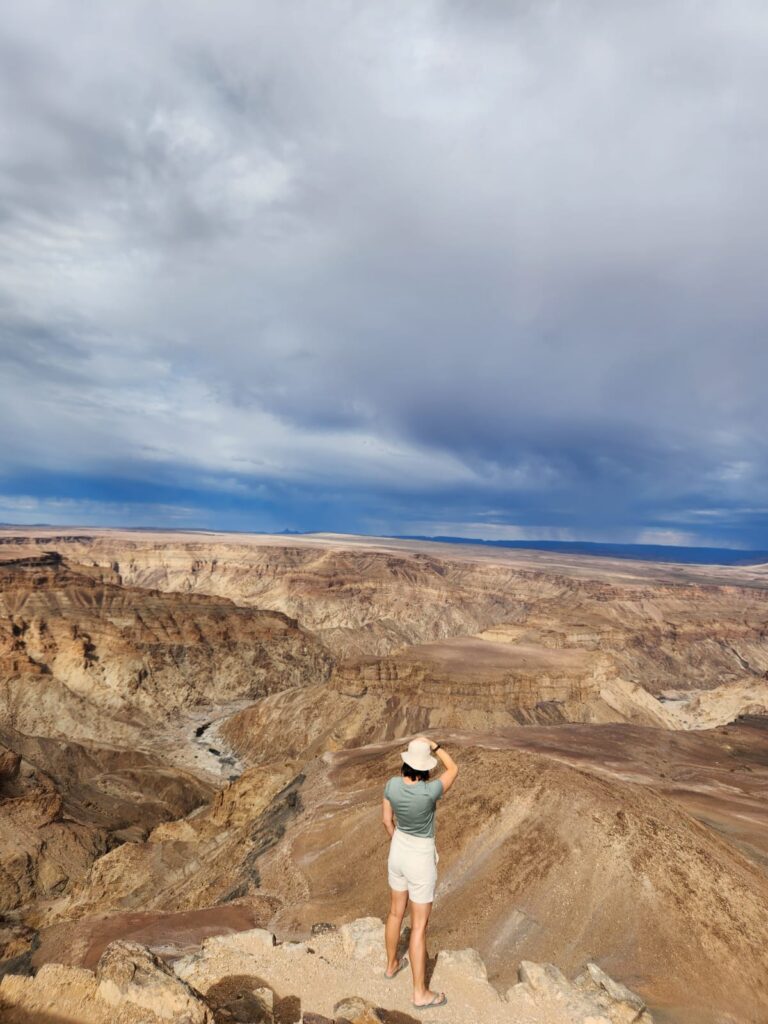
Located within the Richtersveld Transfrontier National Park is the Fish River Canyon. It is the world’s second biggest canyon. The canyon is made up of two layers. The lowermost layer of the Fish River Canyon is predominantly formed by the Nama Group. This group consists of ancient sedimentary rocks, including shale, sandstone, and quartzite. These rocks were deposited millions of years ago when the region was covered by seas and river systems. The Nama Group’s sedimentary layers can be observed in the lower parts of the canyon, contributing to its overall structure and geological history. Above the Nama Group, the Karoo Group forms the uppermost layer of the Fish River Canyon. The Karoo Group is also composed of sedimentary rocks, primarily shale and sandstone. These rocks were deposited during the Permian and Triassic periods, around 300 to 200 million years ago. The Karoo Group’s distinctive layering is visible in the canyon’s towering cliffs, with various shades of red, orange, and brown hues.
We were lucky enough to see the rainfall across the Fish River Canyon, which is not a common sighting. Maaaaaybe if the future allows, we’d love to be back to hike the tough and well known 5-day trail which begins just here in the photo below.

Duwisib Castle
After a pleasant stay during our previous Namibia trip in 2019, we returned to spend our second evening at Duwisib Castle. That rain that we had seen in the distance from Fish River Canyon had caught up to us after we set up camp. We had nowhere to hide but the bathroom. So, the four of us ran for cover and admired the rainfall. The rain cooled down the earth, the bugs and clouds soon disappeared, and we were greeted with a(nother) beautiful rainbow. This camping evening goes down as one of our top 5 favourite camping experiences ever. It had set the exciting atmosphere for this well awaited Namibian trip. We were the only campers, with an incredible view of the castle, with no wind whatsoever, colourful skies, occasional jackal cries in the distance and ended it with a scrumptious dinner around a crackling fire.


From Duwisib Castle, we headed to the capital city of Namibia, Windhoek. Shortly after leaving Duwisib Castle, Alicia and Rean who was driving behind us told us that they saw a thick black cobra in the middle of the road slithering towards our car, lifted itself up and tried to hit our tyre (while we were driving about 60km/h). We completely missed this sighting! During this journey, I had managed to slash our one tyre with a sharp rock on the rough dirt road. Or maybe it was the cobra, who knows? Jokes. It was definitely a rock. We had no choice but to replace the damaged tyre. We were only 3 days into our journey and we had to replace a tyre. Goodness knows what lies ahead of the remaining two weeks. My driving confidence hit an all-time low. In Windhoek, we enjoyed dinner at a restaurant/pub called Joe’s Beerhouse. If you’re feeling experimental, you can choose from various meats, including a kebab made up of a springbok, kudu, zebra, oryx or even try crocodile.

Etosha Nature Reserve
As you approach Etosha Nature Reserve, you’ll spot the ant nests. Picture yourself back at the beach, where you take runny sand and let it drip on top, to form that A shape. Think that, 2.5m high and super hard. That’s what these ant nests look like all around. Given the season, and the fact that we were in Northern Namibia, Etosha had a lot of rainfall which made it very green. This made the spotting of animals a tad bit more challenging and the animals also didn’t have the need to gather at the waterpoints located in various locations in the reserve. We had a little bit of rainfall every single day. We spent one evening per campsite. We stayed at Namutoni, Halale, Okaukuejo and Olifantsfontein campsites. Each campsite had bathrooms with warm water, braai area and a lighted water point, which can be accessed by foot within the campsite. And of course, the night skies show off their shooting stars talents. The campsites vary between 70km and 140km away from each other. So, we spent the whole day on the road, driving maximum 50km p/h exploring the Nature Reserve and spottin many animals, birds and other cool things along the road, in the direction of our next campsite.
The most memorable thing of the few days spent in Etosha were the the lighted water points. Everybody that is there, sits in absolute silence. You could drop a pin and hear it. The audience watches the animals come and go in awe. Listening to every ruffle, moan, roar, slurp, footstep made by whatever animal. We were lucky to see herds of elephants with their calves, a crash of rhinos and their calves, dazzle of zebras and their foal. Before you know it, you’ve spent an hour and a half in complete silence watching every single movement, waiting to see what comes out of the bush to drink or play in the waterhole.


During our visit, we spotted over various birds including lilac breasted rollers, secretary birds and wild animals such as wildebeests, oryx, giraffes, lions, zebras, springbucks, rhinos, elephants and jackal.


Our highlight of Etosha Nature reserve would definitely be when we arrived at the pans. Man, oh man. It’s made up of kms and kms and kms and kms and kms of nothing but cracked ground that lies before you. In the distance you can’t tell if it’s a mirage, mountains, trees or just your eyes that can’t adjust staring into the distance and see nothing.


Olifantsrus campsite also had an extraordinary two-story viewing deck, surrounded by a pool of water where you can look out into the wild. Upon arrival, there was an elephant right there, facing the viewing deck. We started off on the first floor, where we could look down at the elephant playing in the water. But it’s the ground floor that blew our minds. It’s a room made out thick glass, staring straight into the elephant. The elephant is so close, you can count its eye lashes, see it blink, you’re able to see every wrinkle on its skin, you can see the detail on its tusk, see how its foot looks like while it walks. It’s just an incredible moment and realisation of how small we humans actually are. We spent hours staring into this wonderous creature and kept pinching ourselves to remind us that this was real.


Olifantsrus campsite is also remembered as an elephant abattoir which was used in the 1980’s. Sadly, 525 elephants were killed in order to reduce the elephant count within the area. The enormously sized equipment used for the execution is still on site and leaves an eerie feeling. It’s not the greatest story to read, but it happened. There were three criteria’s that had to be met before the elephants were slaughtered:
- The whole tribe had to be killed and it had to be done as quick as possible
- The slaughtered elephants were used for research (reproductive systems, fetus etc.)
- The slaughtered elephants were canned and eaten

Leaving Etosha Nature Reserve heading to Cape Cross
When we left Olifantsrus, Google Maps initially scheduled our road to be 390km, but soon after the (one too many) roads it wanted us to take (which didn’t exist), our journey got extended by an extra 40km or 50km at a time. Eventually, by the time we made it out of the Nature Reserve, our route’s estimate recalculated to an unexpected 540km. Oh dear, this day just got interesting. The below sections are all related to this very long journey to Cape Cross.
Passing through Kabajang village
If you exit Etosha National Park from Galton gate, you will reach a village within 20km after that has a petrol station and a well stocked Spar-Sav More. However, upon entering the little town the whole population is there to welcome you and try sell their arts and crafts. Some of the locals are dressed in their traditional wear. So, you will find topless woman dressed in long bead necklaces and with their colourful skirts. We had the petrol attendants and shop owners distancing the community from us so that we could get out of our cars to shop and get back into our cars. There was no threat or harm, it was just an overwhelming amount of people trying to get your attention. Probably the closest scenario of feeling like a celebrity among all the paparazzi.
Grootberg Pass
After Kabajang village we drove past the gorgeous 10km Grootberg pass. As you drive through the pass you will explore Damaraland, one of Namibia’s scenic routes. It is known for its rocky landscape, white grape trees, and red sand as well as its wild animals like oryx, elephants, giraffes and rhinos.


As we approached Palmwag we approached what look like a very tall statue from a distance. Nope! It moved! A free roaming giraffe! We saw a wild giraffe; no barriers, no gates, no guardians, nothing. Woah!! How luckily is that little village to own their own a giraffe. Or an excellent escape artist, who knows?

Drive the Skeleton Coast
We reached the Skeleton Coast from the C39, still heading towards Cape Cross. This 100km stretch of road was rough with a lot of sharp rocks which resulted in our second puncture for the trip. Luckily this time around, we didn’t need to replace the tyre but a simple patch. And then 4km driving on the Skeleton Coast, the Renault got it’s first puncture, and it needed to be replaced with the spare wheel.


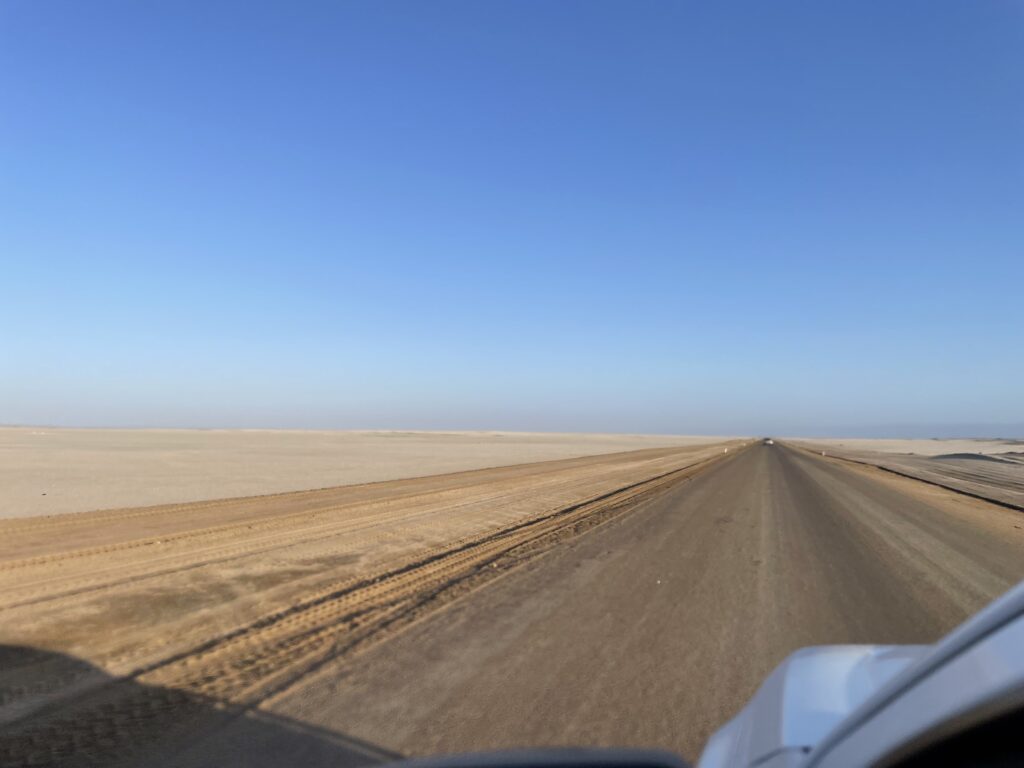
In order to drive on the Skeleton Coast road, you have to enter the park during its open hours. In order to enter, you will enter their office and provide your details and the car details and obtain a license to drive through. This is free of charge and for the purpose of keeping count of who is in the park. We entered the park and drove 220km on the C34 with the sea on one side and the dunes on the other side. You’ll be tempted to surpass 120kph. Don’t be fooled by how straight this road is. There are multiple gradual humps to regulate the speed.


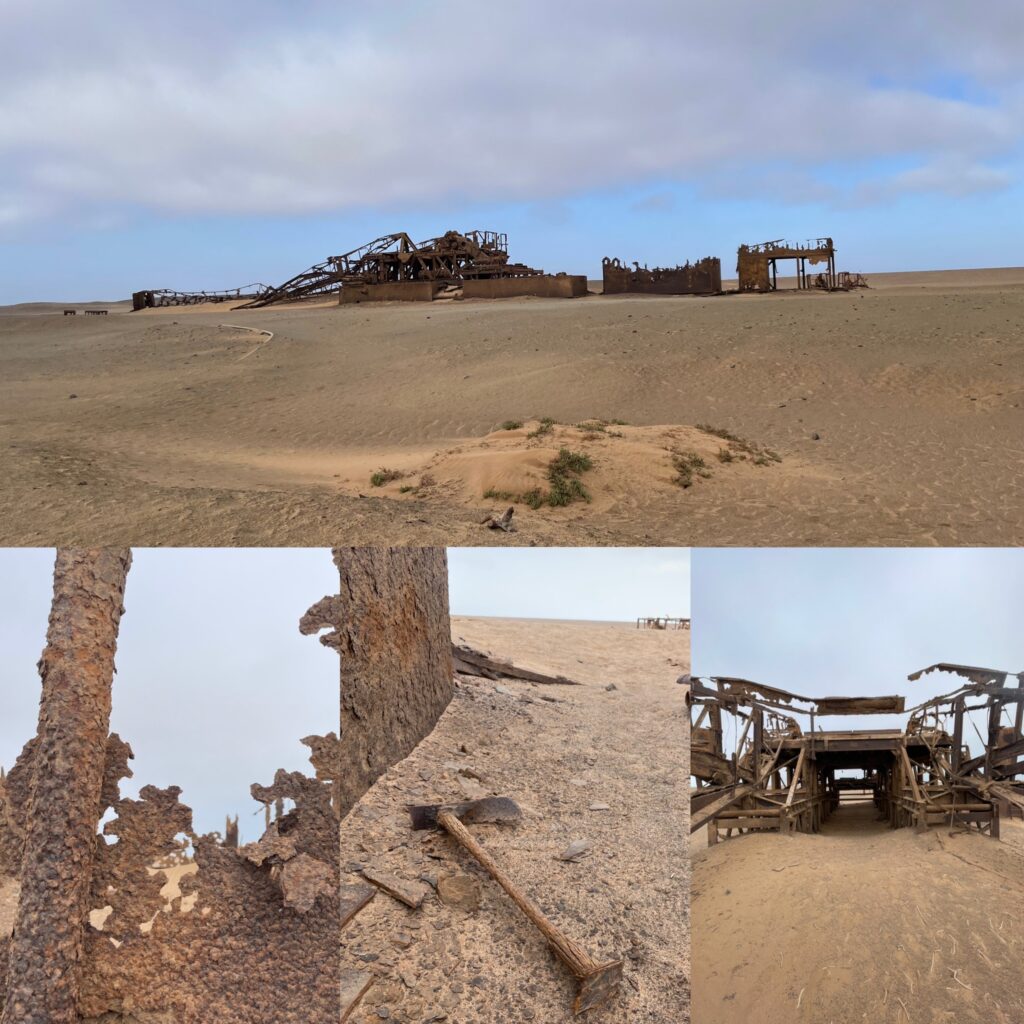
While driving the Skeleton Coast, be on the lookout for the oil rigs and shipwrecks that can be seen on the sides. You are allowed to get out and take photos.
During your drive, you will spot long flat plants that look dead. Don’t be deceived, they’re very much alive and it’s their way of surviving the harsh conditions of living in the desert. This plant is called Welwitschia. They’re known to live for over 1,000 years.
Cape Cross
Out of the whole trip the Cape Cross Lodge campsite was the one we were most skeptical about, not knowing what to expect given it’s location on the skeleton coast. Every few mile on the skeleton coast, you’ll pass various places with “Mile” followed by a number. These marked locations are popular among fisherman who either spend their day catching fish or launching their boats into the sea to do deep sea fishing. However, to our surprise, the Cape Cross Lodge campsite, their lodge’s restaurant, food, staff and atmosphere was great! After sending this photo to one of the family members, we were asked how we ended up in Baghdad. LOL.

You can expect lots of wind and rain at the coast during this time of season. We spent two days at Cape Cross and explored the surroundings. If you walk along the seashore, you’ll commonly find dead seals washed up on shore. Jackal and seagulls would feed on it within a couple of days. During our stay at Cape Cross, we explored the Dead Sea in the middle of the dunes as well as the Cape seal colony.
We continued driving on the Skeleton Coast until we found an area with rocks piled up on a hill. We stopped and got out for a Geocache. We were prompted to pick up a rock and hit it against a an upside down U-shaped hollow (bottomless) rock, it made a chiming bell sound. A sound similar to the bell that you would hear during the Tour de France.


After sounding the chiming bells, we set back into the car and hit the Skeleton Coast road, until we found the sign indicating “Dead Sea 17km” heading into the dunes direction. There is no designated road, so you try to find the most recent tyre marks on the sand and follow that. The first kilometre was heavily corrugated and I believe served as a test to see the car and the driver’s ability to handle the remaining 16km and the journey back. We managed to push through, and wow, what an achievement and so worth it. The desert turned into our playing field. Along our journey we found pink medium shaped rocks. We first they were salt rocks, (yes, we licked them to confirm), and they weren’t. They were rose quartz. Incredible!


We finally arrived at the old mine hole with its water residue. The water consisted of concentrated minerals and salt. The water density is very high, thus the reference to the Dead Sea. The water texture felt heavier and smoother (like a subtle oil feeling). I dunked my hands and feet into the water. After doing a week of camping you don’t realise how many small cuts you have on your feet and hands. It burns the instant you make contact with the water, but guarantees a faster and cleaner healing. After removing my hands and feet from the water, the salt instantly crystallised on my skin. I enjoyed n unexpected and pleasant salt scrub. Take along a 5L water bottle to rinse it all off.


The Cape Cross Seal Colony was next up on the list to visit. It’s the largest breeding colony in the world. Imagine 200,000 Cape fur seals spread across the sea, the shore and on land. They were surfing waves, catching fish, chilling on the shore, walking around or sleeping. What did they all have in common? They all growl and grunt. Seals are actually very possessive of their space. Given how many seals there are in that specific area, they fuss and fight the whole time. You’ll spot the odd one purposefully stirring up a fight by going and laying on top of other seals, causing all affected seals to fuss, move or fight them off. Did you know they have claws on their unharmful looking fins? One of the controversial subjects is the seal execution that takes place annually. This is done to control the numbers. Something we also found out was that this seal colony eats more fish than Namibia and South Africa’s fisheries combined. There’s a wooden walkway that you can use to walk between the seals. It becomes a hilarious scene when a seal (or more) enters the walkway and corners people. Good luck to who ever gets out first! They are feisty marine mammals. After this trip, you’ll leave with nothing but one memory, the direction the wind blew. When it blew, it blew the seal excrement, dead seal, fish smell all mixed with the normal sea smell up your nose and there to stay. Pack in your buff or mask.


After the Cape Cross Lodge we head to Swakopmund. This was our two day stay where we relaxed at an AirBnb, got good nights rest in and freshened up. Swakopmund is central enough to explore a few fun activities.
Drive in the sands of Walvisbay
You’ll pass some of the salt manufacturers as you head to the sand routes. We passed the salt manufacturers that were still operational even though it was a Saturday afternoon. After spotting the sign indicating the route leading into the sand, we thought we would go in for a couple of metres to test how far we could go in. Engaged in 4×4 low range, full of confidence, knowing we had all the equipment needed to get ourselves out of a situation, we hit the gas pedal. We made it, a whopping 15m in. The Ford Ranger went in with everything it had, and died within seconds after entering the super thick sand. The Duster behind us, maybe made it a few metres in before also getting stuck. There was a group of German visitors nearby that seemed to wait exactly for that to happen. They were stoked to offer help and get us out of our situation with their vehicles.

Restaurants and pubs in Swakopmund
There are various German inspired restaurants, shops and bars to visit and explore. We also enjoyed a drink at the beautiful Hansa Hotel’s bar.
Quad Biking in the dunes in Swakopmund
So have you ever have that longing to be happy as a child? So happy that you can’t contain the excitement and scream? And nobody can hear? That’s what you will experience when quad biking for an hour in the sand dunes on Namibia. We used Desert Explorers and would highly recommend them. From the various adventure options to choose from, to online booking and having a fun guide, you’re in for an adventure of a lifetime. We opted for the 1.5 hours of quad biking. We reached 70kph, going up and down dunes, skidding across the sands, and at one point, stopping to observe your surroundings and take in the pure nature of seeing nothing but dunes around you. Quad biking down the dunes is one of the most thrilling experience you can have!


Sossusvlei
We got up early to be one of the first cars in line to enter the Namib Naukluft Reserve to visit Sossusvlei. We waited between 30 to 45 minutes in line to catch the dunes at their cleanest (of footsteps from the previous days’ visitors). After entering the gates, it took another hour before reaching Big Daddy dune. It also consisted of driving through thick sand which required 4×4. You don’t want to get stuck in the sand, it will easily cost you over a thousand Namibian Dollars to tow your car out. We arrived at the start of Big Daddy, applied sunscreen, grabbed our hats and water bottles and started the hike up the dune. It took us a diligent 1.5 hours to reach the top. But we did it! Unlike our previous attempt a few years ago, where we thought we’d be clever and hike the dune up directly, rather than follow the actual path. Needless to say, we had only made it up 3/4 up before running it down, defeated. Back to this experience, once we reached the top of the dune, it took us 10 minutes to run down. It is such a satisfying and fun way to celebrate the accomplishment! We both also had a moment to celebrate our accomplishment of finishing our Masters degree. The day we peaked Big Daddy, was our graduation day, which we gave up to explore Namibia. We could not have thought of a better way to celebrate it.


After making your way down, the Deadvlei still remains fascinating to observe. After the hike, you are exhausted and the sun beating its heat down on you doesn’t help much. It’s important to hydrate yourself as soon as possible.


Our final night we spent in Klein-Aus. Their camping site, restaurant, food, staff, and hiking trails were fantastic. At the campsite, there’s a short hiking path called the Viewpoint Stone Horse. When you reach the destination and you look down and 600m into the distance, you can see the outline of a wild horse. The formation of the running wild horse is outlined by over 4 000 rocks. We took our binoculars along and we were lucky enough to have spotted five wild horses. Klein-Aus was the perfect way to celebrate, recall all the memories we made over the last 2 weeks of thousands of km of driving, seeing so much and doing just as much. It was such a memorable journey, where friendships were treasured and came back to reality with our cups full again!


Rean & Alicia, thanks for an incredible 2 week adventure together! We became ultimate masters of unpacking and packing our tents up in record time, making the greatest food and enjoyed being in each other’s company! Julle was awesome gewees.


